


Care and the City Panel
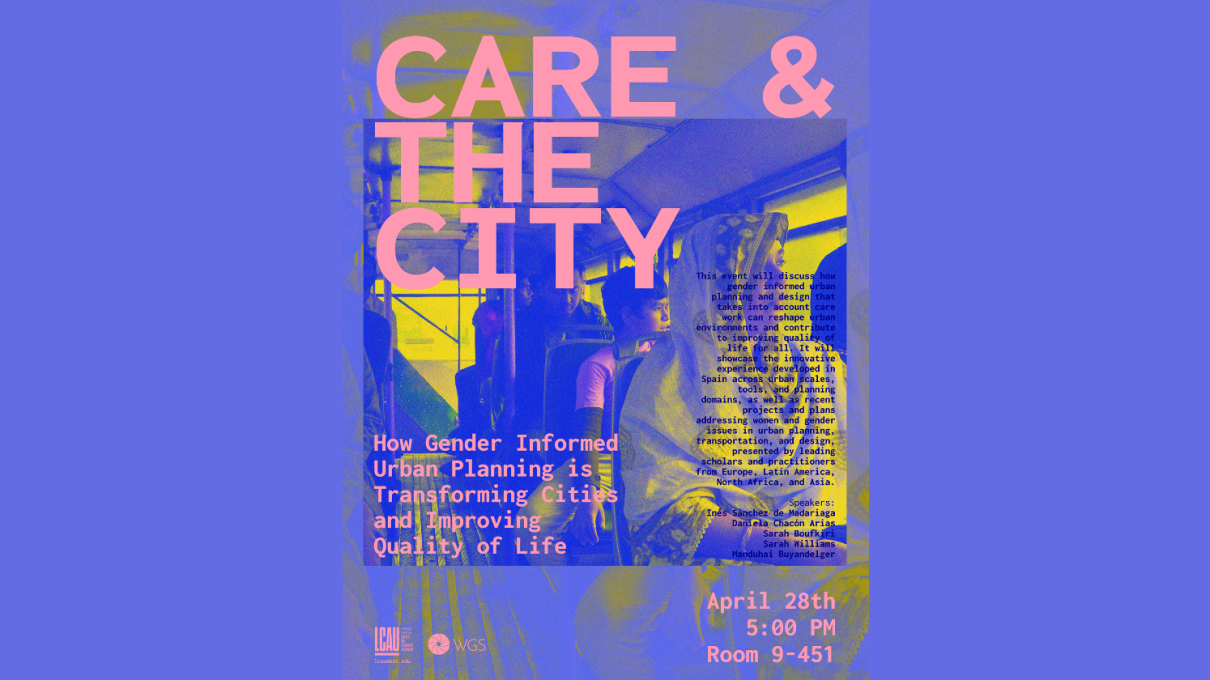
Join us on April 28 to discuss how gender informed urban planning and design that takes into account care work can reshape urban environments and contribute to improving quality of life for all. The event will showcase the innovative experience developed in Spain across urban scales, tools, and planning domains, as well as recent projects and plans addressing women and gender issues in urban planning, transportation, and design, presented by leading scholars and practitioners from Europe, Latin America, North Africa, and Asia.
Please RSVP at this link.
In addition to the in-person event (105 Massachusetts Avenue, Room 9-451, Cambridge, MA 02139). The event will be streamed (link to stream).
This event is sponsored by MIT's Leventhal Center for Advanced Urbanism and MIT's Women's and Gender Studies Program.
Speakers
Inés Sánchez de Madariaga is a Visiting Scholar at the LCAU at MIT and a Fellow at Real Colegio Complutense at Harvard University. She is UNESCO Chair on Gender, Professor of Urban Planning at Universidad Politécnica de Madrid, and Chair of the Advisory Group on Gender Issues to the Executive Director of UN-Habitat. She is a leading international expert on gender in transportation, urban planning and architecture with extensive experience spanning public office, policy, practice, and research. A Fulbright grantee and Real Colegio Complutense Fellow, she has been Visiting Scholar at Harvard University, MIT, UCLA, the Bauhaus-Weimar, LSE, and Columbia University. Inés has held public office in the Spanish Government in the Ministers of Housing and of Science and Innovation. She chaired the Expert Group of the European Commission for gender equality in STI, the Iberoa American and Spanish Biennials of Architecture and Urbanism and is a member of the UNESCO Expert Group to promote women in science. She has been director of over 70 research and consultancy projects funded by local, national and regional governments in Spain, as well the European Commission, the World Bank, the InterAmerican Development Bank, the European Investment Bank, and various UN agencies. Her innovative work on mobilities of care has granted her international recognition around the world.
Daniela Chacón Arias is currently a Loeb Fellow at the GSD, Harvard University. She is cofounder and executive director of TANDEM, an Ecuadorian nonprofit that builds bridges of dialogue and collective action among citizens, civil society, the private sector, and local governments to create more responsive and inclusive cities. Under her leadership, TANDEM has grown into a nationally recognized organization that has implemented over a dozen civic innovation programs across the country. A lawyer and urban policy expert, Daniela served as vice mayor and city councilor of Quito (2014–2019), where she championed initiatives to promote walking and cycling, recover public spaces, and advance gender equity in public transportation. She designed and launched Quito’s first system for reporting sexual harassment in public transit and cofounded the Women in Motion Initiative, a Latin American network promoting women’s leadership in sustainable mobility. She is also a member of the global Placemaking Leadership Council.
Sarah Boufkiri is an architect and project manager based in Rabat, Morocco. Boufkiri works for the Zenata Development Company (Société D'aménagement Zenata), coordinating development projects, overseeing land-use strategies, and collaborating with public and private stakeholders to develop the new eco-city of Zenata. Boufkiri’s previous experience includes coordinating multidisciplinary teams and leading collaborations with public authorities, private investors, and international consultants to deliver complex, large-scale developments. Boufkiri holds degrees in Architecture from the National School of Architecture (ENA), Rabat, Morocco, and Masters in Management of Quality, Health, Safety, and Environment from the International University of Rabat, Morocco. At MIT, Boufkiri aims to harness research and pedagogy strategies to address environmental, economic, and safety challenges and improve living conditions. Boufkiri aspires to shape urban environments that are sustainable, inclusive, and economically resilient, with lasting impact at both local and national levels.
Sarah Williams is an Associate Professor of Technology and Urban Planning at the Massachusetts Institute of Technology (MIT) where she is also Director of the Civic Data Design Lab and the Leventhal Center for Advanced Urbanism. Williams’ combines her training in computation and design to create communication strategies that expose urban policy issues to broad audiences and create civic change. She calls the process Data Action, which is also the name of her recent book published by MIT Press. Williams is co-founder and developer of Envelope.city, a web-based software product that visualizes and allows users to modify zoning in New York City. Before coming to MIT, Williams was Co-Director of the Spatial Information Design Lab at Columbia University’s Graduate School of Architecture Planning and Preservation (GSAPP). Her design work has been widely exhibited including work in the Guggenheim, the Museum of Modern Art (MoMA), Venice Biennale, and the Cooper Hewitt Museum. Williams has won numerous awards including being named one of the top 25 technology planners and Game Changer by Metropolis Magazine. Check out her latest exhibition, Visualizing NYC 2021, at the Center for Architecture in New York City.
Manduhai Buyandelger is an anthropologist of religion, gender, and politics, with regional expertise in Mongolia. Her early work centered on cultural memory and religious practices among ethnic Buryats. She investigated the proliferation of shamanic practices during the first decade of postsocialism, examining how these activities contested both Soviet and Enlightenment-based values of secularism and rationality. Tragic Spirits: Shamanism, Gender, and Memory in Contemporary Mongolia (University of Chicago Press, 2013) won a 2014 Francis L.K. Hsu book prize from the Society of East Asian Anthropology and was shortlisted as one of the top five social science books on Asia by the International Convention of Asia Scholars (ICAS) in 2015. Her second book, A Thousand Steps to the Parliament: Constructing Electable Women in Mongolia (University of Chicago Press, 2022), turns to a wider national Mongolian stage, looking at electoral politics, with the particular aim of documenting and analyzing the fortunes and subjectivities of women who are running for parliamentary office. It won 2022 Mongolian Anthropology Association Best Book Prize, and Mongolian Writers Association 2023 Golden Quill Pen award for the best book in a category that addresses human rights issues.