


Future Mobility
Sidara-MIT Seed Grant recipients create framework for co-designing future mobility systems
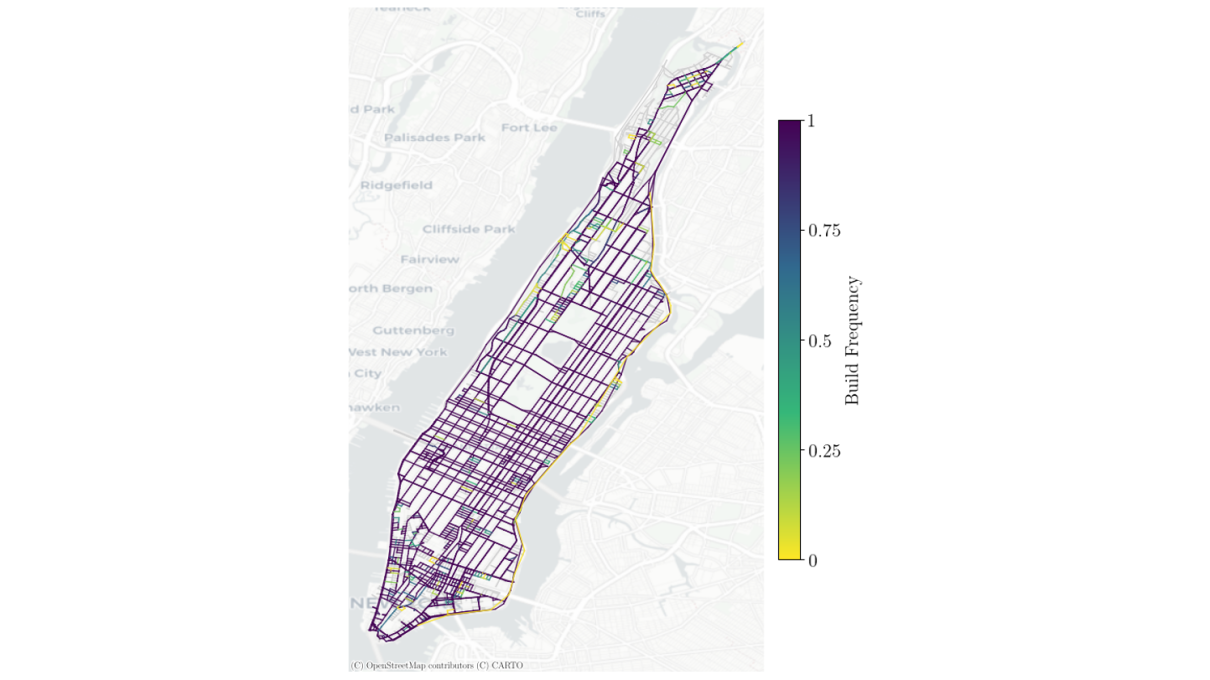
Image: A month of Manhattan demand simulations reveals the streets most consistently worth instrumenting for autonomous vehicles for on-demand (robotaxi) service, highlighting a robust network for autonomous operations under budget and fleet constraints. Credit: Li et al., 2026
Rapid urbanization and the push toward sustainable transportation create complex challenges for cities. Questions around efficiency, equity, and environmental goals, which often need to be balanced, arise when designing mobility systems. With support from the Sidara-MIT Urban Seed Fund, an interdisciplinary team led by Gioele Zardini of MIT’s CEE/LIDS/IDSS aims to address these questions in the context of emerging mobility technologies in the urban environment.
The project, titled “Co-Designing Future Mobility Systems,” develops a data-driven co-design framework that brings together urban planners, policymakers, and operators to optimize urban mobility solutions. So far, the team has mapped and standardized the autonomous mobility-on-demand research landscape, developed efficient routing algorithms for shared, high-capacity shuttles, and is now modeling how private mobility operators, transit agencies, and municipalities can coordinate policies to improve system-wide performance. They've also identified Riyadh as a key pilot city given major investments in transport infrastructure and preparations for large-scale global events such as Expo 2030.
Impact
This project introduces a novel approach to mobility planning by developing the formalism to model both operations and interactions among municipalities, operators, and users, while balancing priorities such as costs, emissions, accessibility, and reliability. The team aims to integrate generative AI into the next phase of the project to create realistic future scenarios and demand shocks (e.g., special events, land-use shifts, other disruptions). This approach allows for the evaluation of designs under uncertainty, advancing how government agencies and their mobility partners can make more informed decisions about transportation infrastructure and policy.
The result will be a reusable framework, data guidelines, and case studies that help public and private decision-makers make faster, better-supported choices under uncertainty.
Support from Sidara
As part of Sidara’s support for the project, the MIT team meets regularly with Sidara to discuss progress, receive feedback, and consider how this research can be taken to practice.
The team is also working with Professor Marco Pavone of Stanford University, providing expertise in AI-driven decision-making. This collaboration promises new advancements in the urban application of generative AI technologies, which will be combined with exact optimization methods to give provably optimal solutions.
Established in 2018, the Sidara Urban Seed Fund is administered by MIT’s Leventhal Center for Advanced Urbanism (LCAU) and invests in research that will create more sustainable and livable cities. Since its creation, 14 grants have been awarded across MIT in diverse fields, from artificial intelligence to cultural heritage.
Next Steps
Moving forward, the researchers plan to run an initial set of pilot experiments, further model the mobility ecosystem in Riyadh, build a collaborative co-design framework incorporating key system components (transit, roads, freight, parking, pricing), and calibrate the models using real-world traffic and transit data from Sidara.
When complete, the project will help policymakers identify high-leverage investment opportunities and policy levers, while accounting for trade-offs in performance, costs, and other stakeholder interactions.
This work has been generously supported by a Sidara Urban Research Seed Grant. Learn more about the LCAU’s collaboration with Sidara.
Team
- Gioele Zardini (Lead PI), Rudge (1948), and Nancy Allen, Assistant Professor in the Department of Civil and Environmental Engineering, MIT
- Jinhua Zhao (co-PI), Director of The Urban Mobility Lab and Professor of Cities and Transportation, MIT
- Marco Pavone, Associate Professor, Department of Aeronautics and Astronautics, Stanford University
- Xinling Li, Graduate Student in Civil and Environmental Engineering, MIT
- Riccardo Fiorista, Graduate Student in Civil and Environmental Engineering, MIT
- Meshal Alharbi, Graduate Student in Electrical Engineering and Computer Science, MIT
- Runyu Zhang, Presidential Postdoc in Civil and Environmental Engineering, MIT
Publications
- X. Li, D. Gammelli, A. Wallar, J. Zhao and G. Zardini, "Accelerating High-Capacity Ridepooling in Robo-Taxi Systems," in IEEE Robotics and Automation Letters, vol. 11, no. 3, pp. 2450-2457, March 2026, doi: 10.1109/LRA.2026.3653376
- Li, X., Alharbi, M., Gammelli, D., Harrison, J., Rodrigues, F., Schiffer, M., ... & Zardini, G. (2026). Reproducibility in the control of autonomous mobility-on-demand systems. IEEE Transactions on Robotics.
- Li, X., & Zardini, G. (2026). Where Should Robotaxis Operate? Strategic Network Design for Autonomous Mobility-on-Demand. arXiv preprint arXiv:2602.19341.
- Li, X., Zhang, R., & Zardini, G. (2026). Implementation-Based Incentive Design for Autonomous Mobility-on-Demand and Transit Systems. arXiv preprint arXiv:2605.18687.